The Right Agent.
For Every Task.
Governed by Default.
Syllabus is a governed AI agent marketplace that matches tasks to the best available agent by capability, not by hardcoded routes. Seven specialized agents, fourteen tools, and full governance integration with Axis. Deploy AI capabilities without building them from scratch.
Finding and Trusting AI Agents
The AI ecosystem is fragmented. You need document classification, which model? Which provider? You need PII detection at scale, build it yourself or buy it? You need legacy code analysis, where do you even start? And once you find an agent that works:
How do you know it is safe? Does it handle sensitive data correctly? Has it been validated?
How do you swap it out? If a better model launches tomorrow, can you switch without rewriting your pipeline?
How do you track what it costs? Not per month. Per operation. Per document. Per agent.
How do you ensure governance? Does every invocation get audited? Is PII scanned? Is there a compliance trail?
Today, organizations hand-wire agents into their applications. Each integration is custom. Each swap is a project. Each audit is a scramble.
Syllabus makes agent selection automatic, agent governance mandatory, and agent swapping trivial.
Marketplace + Toolkit
Syllabus is two things at once: a governed registry for agent discovery and management, and a production-ready toolkit of seven built-in AI agents.
A Marketplace
A registry of AI agents organized by capability, with governance metadata, version management, and performance analytics. Discover and manage agents from any provider.
A Toolkit
Seven production-ready AI agents with fourteen MCP tools for document analysis, legacy modernization, PII protection, and human-in-the-loop notifications. Use immediately.
Capability-Based Agent Resolution
When Axis needs an agent to classify a document, it does not call a hardcoded endpoint.
It asks Syllabus: "Which registered agent has the document.classify capability,
is currently ACTIVE, meets the governance requirements for this tenant, and has the best performance metrics?"
Syllabus resolves the query, scores available agents, and returns the best match. If that agent goes down, the next-best agent takes over, no pipeline changes required.
Discovery Protocols: A2A and Skan AOW
Syllabus agents publish Agent Cards at /.well-known/agent.json,
following Google's A2A protocol. Each Agent Card advertises capabilities, provider,
version, supported skills, and input/output modes. External systems can discover
Syllabus agents through standard A2A discovery without Novus-specific integrations.
Syllabus registers agent capabilities using AOW's standardized vocabulary for intents, skills, and policies. Third-party agents and Syllabus built-in agents compete on equal footing. Best agent wins, regardless of origin.
Both protocols feed into the same governance pipeline. Discovery is open. Governance is non-negotiable.
Seven Production-Ready Agents
These are not demos. They are production-validated tools with measured accuracy and real throughput numbers.
Document Analysis
Business Rule Extraction
Extracts business rules from legacy source code: COBOL, Java, C/C++, PL/SQL, Visual Basic, Perl, Fortran, and more. Returns structured rules with conditions, actions, categories, and confidence scores.
Why 102.8%? The LLM finds implicit rules, conditional logic buried in nested IF statements that human documentation missed.
Document Triage
Intelligent document classification and routing. Submit any document and get back: classification, confidence, priority, suggested routing, and extracted entities.
PII Protection
Scans text for personally identifiable information and tokenizes it. GDPR and CCPA compliant. Detects SSNs, names, emails, phone numbers, addresses, credit cards, policy numbers, DOBs, and driver licenses.
Enterprise Data Privacy
Bulk PII processing at scale. Point it at a directory of documents and get back a compliance report with per-type PII counts, anonymization results, and audit-ready documentation.
Documentation & Metrics
Rule Documentation
Takes extracted business rules and produces formatted documentation in markdown, HTML, PDF, JSON, or Excel. Turn legacy code analysis into business-readable process documentation.
Advanced Documentation
Comprehensive multi-format documentation with templates. Generates complete filing packages, regulatory response memoranda, and technical documentation with diagrams.
Processing Statistics
Introspection agent that reports usage metrics, agent metadata, and supported operations across the entire Syllabus platform. Used by Axis for health monitoring and telemetry.
Human-in-the-Loop Alerts
When AI operations require human attention, Syllabus handles the notifications. Each notification type has a structured template designed for its audience.
Collision Alerts
When Koda detects a logical contradiction, Syllabus sends a structured alert to the assigned analyst with the collision summary, severity level, formal proof, IPFS audit link, and action buttons.
Success Notifications
When a filing or document completes processing, Syllabus sends a confirmation with the transaction ID, filing number, blockchain verification hash, and a link to the immutable audit record.
Technical Escalations
When something fails at the system level, Syllabus sends an urgent alert to the technical support team with error codes, stack traces, affected transactions, and recommended actions.
HTML and plain-text versions. Severity-coded coloring. These are not generic email blasts.
Agent Discovery and Governance
Beyond built-in agents, Syllabus is a registry where any AI agent can be published, discovered, and governed.
Agent Registration
Register agents from any provider: OpenAI, Anthropic, Google, custom internal agents, or third-party services. Each registration includes:
Capability Matching
When a pipeline step needs an agent, Syllabus scores all registered agents that declare the required capability. Scoring factors:
The highest-scoring agent gets the task. No manual routing tables.
Governance Policies
Tenant-scoped policies control which agents can execute in which contexts. Policies are declarative. Define them once, Syllabus enforces on every resolution.
Usage Analytics
Track agent performance across your entire catalog with granular metrics and trend analysis.
Powered by Axis Governance
Syllabus and Axis are designed to work together. Axis provides the governance layer. Syllabus provides the agent intelligence.
Integration Flow
pipeline_id: document-analysis
routing_mode: CAPABILITY_BASED
steps:
  - step_name: classify
    capability: document.classify
    required: true
  - step_name: extract_pii
    capability: pii.detect
    required: true
    input_from: steps.classify.output
  - step_name: extract_rules
    capability: rules.extract
    required: false
    input_from: steps.classify.output
  - step_name: generate_docs
    capability: docs.generate
    required: false
    input_from: steps.extract_rules.output
No agent IDs in the manifest. Only capabilities. Syllabus resolves the agents at runtime. Swap providers, upgrade models, add new agents. The pipeline does not change.
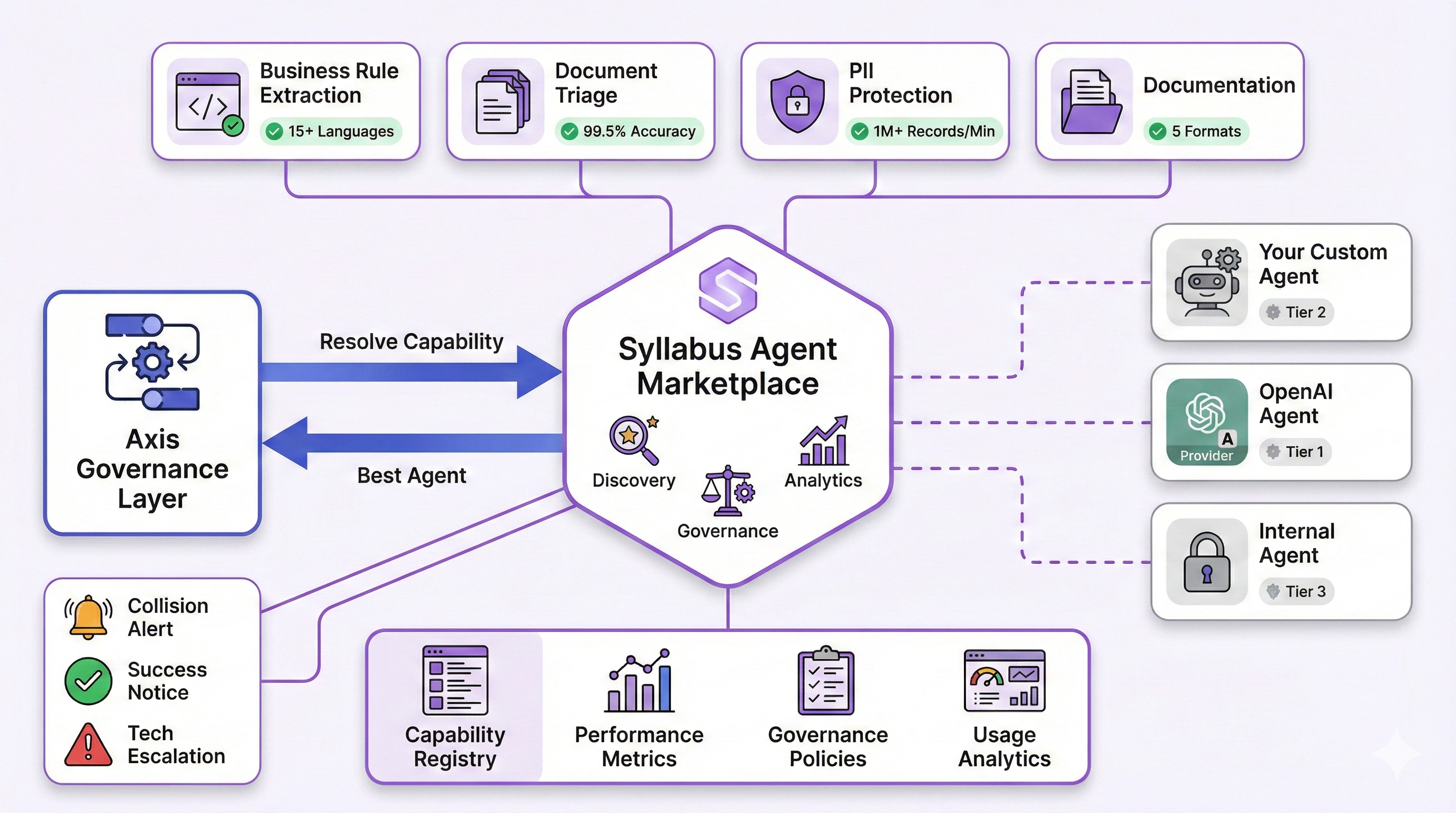
Figure 1: Syllabus Marketplace Architecture - Agent Discovery, Resolution, and Governance
Real Results, Real Numbers
Business Rule Extraction
PII Detection at Scale
Integration Testing
Multi-Provider, Multi-Model
Syllabus agents are not locked to a single LLM provider. Provider fallback is automatic. If the primary provider is unavailable, Syllabus routes to the next available provider without pipeline interruption.
OpenAI
GPT-4, GPT-4o
Primary for rule extraction and documentation
Google Gemini
1.5 Flash, 1.5 Pro
Primary for concept analysis and triage
Anthropic Claude
3.5 Sonnet, Opus
Fallback and specialized analysis
Custom Models
Your fine-tuned models
Bring your own via standard HTTP endpoints
MCP Tools, SDK, and Integration
import httpx

# Extract business rules from legacy COBOL
response = httpx.post("http://syllabus.novus-forge.com/mcp", json={
    "jsonrpc": "2.0",
    "method": "tools/call",
    "params": {
        "name": "extract_business_rules",
        "arguments": {
            "code": "IF AGE > 25 AND COVERAGE-TYPE = 'HO3' THEN PREMIUM = BASE-RATE * 0.95",
            "language": "cobol"
        }
    },
    "id": 1
})

rules = response.json()["result"]["rules"]
for rule in rules:
print(f"Rule: {rule['condition']} -> {rule['action']} (confidence: {rule['confidence']})") {
"mcpServers": {
"novus-syllabus": {
"command": "python",
"args": ["-m", "syllabus.mcp_server.server"],
"env": {
"OPENAI_API_KEY": "...",
"GEMINI_API_KEY": "..."
}
}
}
} Add Syllabus directly to Claude Desktop for conversational access to all 14 MCP tools. Extract business rules, classify documents, detect PII, and generate documentation through natural language.
See the Full Use Case
7 agents, 14 tools, capability-based resolution in the Golden Loop pipeline
See Syllabus in Action
Request a demo to see how Syllabus matches tasks to the best available agent with governance built in from the start.