AI-Powered Filing Analysis Proving What Happened
541 concepts extracted. 550 axioms validated. 1 logical contradiction caught.
Every step auditable, every decision traceable, every result recorded.
Scale Struggles Under Manual Review
Insurance carriers face a compounding challenge: regulatory filings are getting more complex, compliance requirements are tightening, and the analysts reviewing them are overwhelmed.
A single homeowners underwriting manual can contain hundreds of interconnected rules, eligibility criteria, coverage limits, deductible structures, territorial ratings, and exclusions that reference each other across dozens of pages. When one rule contradicts another, the consequences are real; rejected filings, compliance violations, and the possibility of steep regulatory penalties.
Manual review catches some of these issues. But when Rule 47 on page 12 conflicts with Rule 203 on page 89, even experienced analysts can sometimes miss it. The problem is not analysis competence, it is scale. No human can hold 550 logical relationships in their head simultaneously.
And when regulators ask "How did you validate this filing?", the answer today is usually a spreadsheet, email chains, other requirement documents or analyst memory.
How Novus Forge Solves This
Your filing passes through a governed AI pipeline that extracts every business rule, validates them against each other, and produces a complete audit trail automatically.
Document Intake and Classification
The document is accepted, validated, and classified. File type, size, and content hash are recorded. The system determines what kind of filing it is and which processing template to apply.
PII Scanning
Before any AI agent touches the content, mandatory PII scanning identifies and scrubs sensitive data. This is not an optional step - it runs on every document, every time.
Concept Extraction
Koda, Novus Forge's ontology (a structured map of how concepts in a domain relate to each other) analysis engine, reads the filing and identifies every business concept like: coverage types, eligibility criteria, deductible structures, exclusions, and territorial definitions.
In our reference test with a California HO3 manual, Koda extracted 541 distinct concepts from a 330KB PDF.
Axiom Generation and Validation
Each concept becomes a formal logical axiom, a machine-verifiable statement representing a business rule. Koda generated 550 axioms from the HO3 manual, then ran each through a 3-stage validation pipeline.
Collision Detection
This is where Novus Forge finds what humans cannot. The ontology reasoner checks every axiom against every other axiom for logical consistency. In the HO3 test, it detected a CoverageLimitIncrease contradiction, two rules that, applied together, create an unsatisfiable condition.
The system provided a formal proof of the contradiction, not just a flag. 37 coverage gaps and 2 ambiguities were also identified.
- 37 coverage gaps: Found within the HO3 manual
- 2 ambiguities: Found within the HO3 manual
Business Rule Validation
The filing is then validated against your business rules containing the specific underwriting criteria, jurisdictional requirements, and company policies that govern what gets approved. Rules fire automatically, violations are flagged, and every rule decision is logged.
Audit Record Sealing
The complete analysis with every concept, every axiom, every collision, and every rule decision that is made along the journey, is sealed into an immutable audit record anchored to IPFS (InterPlanetary File System), a content-addressable storage system where records are identified by their content hash, making them tamper-evident. It cannot be altered after the fact.
When a regulator asks "How did you validate this?", you hand them a cryptographically verifiable export of the entire process.
Human in the Loop at Every Step
The Glass Box Dashboard gives your team real-time visibility into the entire pipeline, with automatic intervention points when the system needs human judgment.
PII Detection
If the compliance scan finds sensitive data that cannot be automatically scrubbed, the transaction is parked immediately. Your analyst sees exactly what was flagged and decides whether to redact and continue or reject the document.
Axiom Collision
When Koda detects rules that logically contradict each other, the transaction parks with a formal proof of the contradiction. The analyst reviews the conflicting axioms, resolves the collision, and resumes processing.
Semantic Gap
If the ontology engine encounters domain terminology it cannot map to the existing knowledge base, it stops and flags the gap. No silent assumptions. The analyst maps the new terms and the pipeline continues.
Budget or Timeout
If an orchestration exceeds its configured token budget, cost limit, or time window, it parks with full state preserved. No runaway costs. The analyst can adjust limits and resume from where it stopped.
Every parked transaction preserves its complete state: what step it was on, what data it had processed, and why it stopped. Analysts pick up exactly where the system left off. Nothing is lost, nothing is hidden.
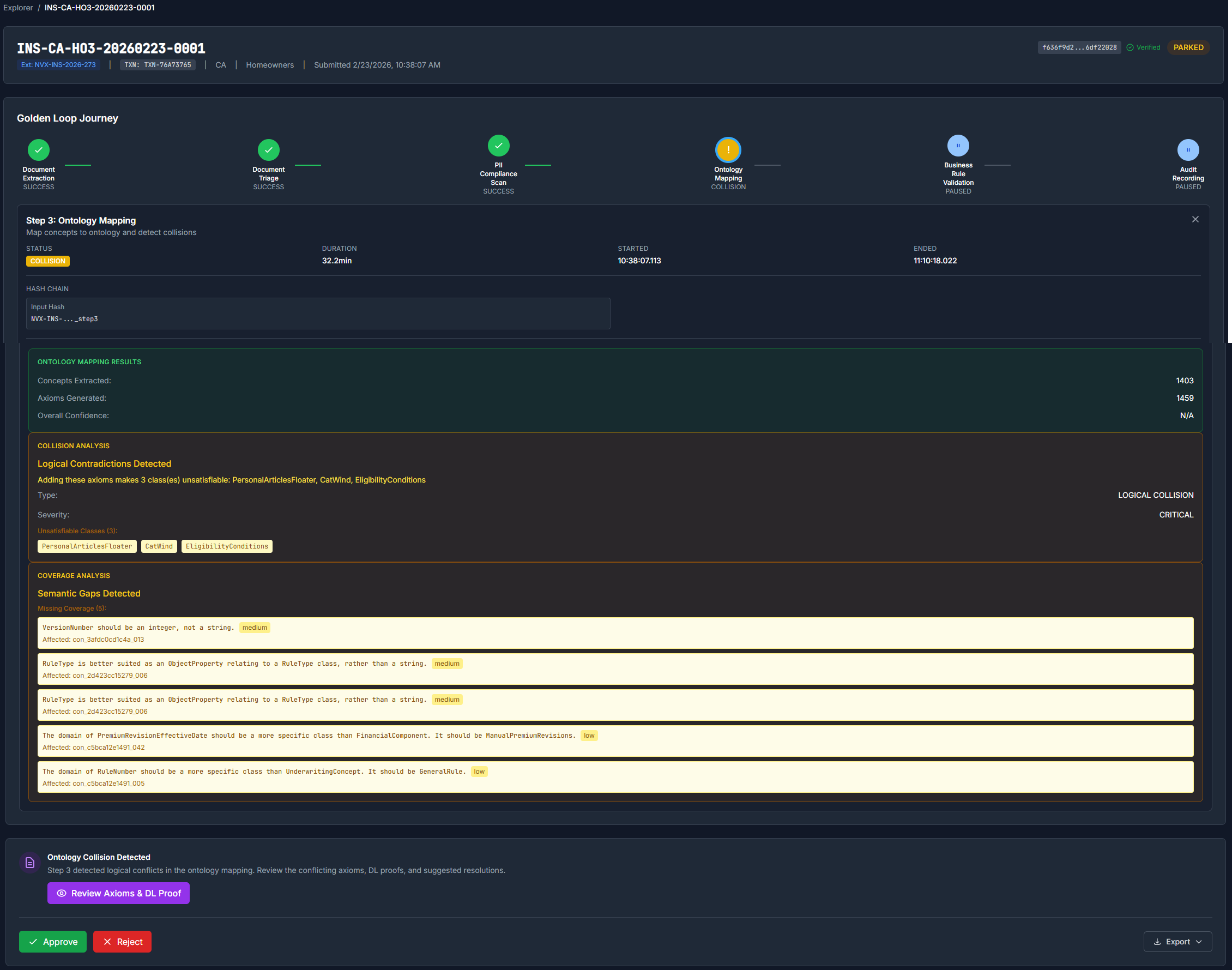
Glass Box Dashboard: Real-time pipeline visibility with human intervention at every governance checkpoint.
Axiom Validation Pipeline
Each extracted concept becomes a machine-verifiable axiom. Here is what the 3-stage validation found.
Logically sound and consistent
Contradicted other rules or regulatory requirements
Refined for precision before approval
Some concepts generate multiple axioms (for example, a coverage rule might produce both an eligibility axiom and an exclusion axiom), which is why the axiom count is slightly higher than the concept count.
Real Results from Real Documents
Not projections. Actual metrics from processing real insurance documents through the Novus Forge pipeline.
SERFF Filing Ingestion
CA Homeowners Underwriting Guide (1,631KB PDF, 844 pages)
| Metric | Result |
|---|---|
| Content extracted | 1,214,881 chars |
| Segments processed | 201 |
| PII instances scrubbed | 3,007 |
| Concepts extracted | 1,403 |
| Axioms generated | 1,459 |
| Axioms approved | 1,000 (68.5%) |
| Axioms rejected | 343 (23.5%) |
| Semantic gaps | 236 |
| Collisions detected | 3 (unsatisfiable classes) |
| Human review triggered | Yes (LOGICAL_COLLISION) |
| LLM calls | 167 |
| Total tokens consumed | 1,289,128 |
| Estimated LLM cost | $0.39 USD |
| Processing time | 32m 13s |
| Audit trail | IPFS-anchored |
Document Ingestion
Underwriting Guide (362KB, 37 pages, 54,990 chars extracted)
| Metric | Result |
|---|---|
| Concepts extracted | 673 |
| Axioms generated | 588 |
| Axioms approved | 445 (75.7%) |
| Axioms rejected | 51 (8.7%) |
| Semantic gaps detected | 36 |
| Human review triggered | Yes (SEMANTIC_GAP) |
| Total tokens consumed | 503,553 |
| Estimated LLM cost | $1.51 USD |
| Processing time | 11m 45s |
| Ontology version | 1.0.25 (1,613 axioms) |
| Audit trail | IPFS-anchored |
These numbers reflect a real production run on this document. The audit trail is cryptographically sealed in Codex. What happened is verifiable, not just logged. That is the difference between AI assistance and AI governance.
"I can see exactly what the AI did at every step. Not a summary - the actual decisions, the actual rules that fired, the actual proof of why a collision was flagged. And I can export the entire thing for our regulators in one click."
What Your Compliance Team Gets
-
Complete visibility into every AI decision, not just the final output
-
Exportable audit trails in JSON or PDF format, ready for regulatory review
-
Collision explanations with formal logical proofs, not just "conflict detected"
-
Human-in-the-loop controls when the AI is not confident, it stops and asks
-
Immutable records once sealed, the audit trail cannot be modified by anyone
Built for Your Workflow
Your existing systems submit filings through a REST API and get back structured results with a compliance receipt proving every governance step ran. No portal to log into. No workflow to change.
The response includes complete analysis results, a compliance receipt with cryptographic proof that PII scanning, audit logging, and governance ran, plus links to the full audit trail and decision trace.
The Glass Box Dashboard lets your team watch the analysis happen in real-time and intervene on flagged items, but submission and integration happen through the API.
{
  "template": "golden-loop-insurance",
  "input": {
    "document": "your-filing.pdf"
  }
}- Complete analysis results
- Compliance receipt (cryptographic proof)
- Links to full audit trail and decision trace
Quick Facts
Homeowners, Renters, Auto, Commercial Property
California (reference), expanding to all US states
ACORD-aligned ontology, NAIC/SERFF compliance
Cloud (AWS), on-premises, or hybrid
REST API, Python SDK, CLI
IPFS-anchored, immutable, JSON/PDF export
See It With Your Filing
Submit a filing through our pipeline and get back a full analysis: every concept extracted, every rule validated, every collision detected, with a complete audit trail.
Pricing is based on orchestration volume and deployment model. Contact us to discuss options for your organization.